Skip to content
Search
Menu

We earn a commission if you book through this link. You pay the same price.

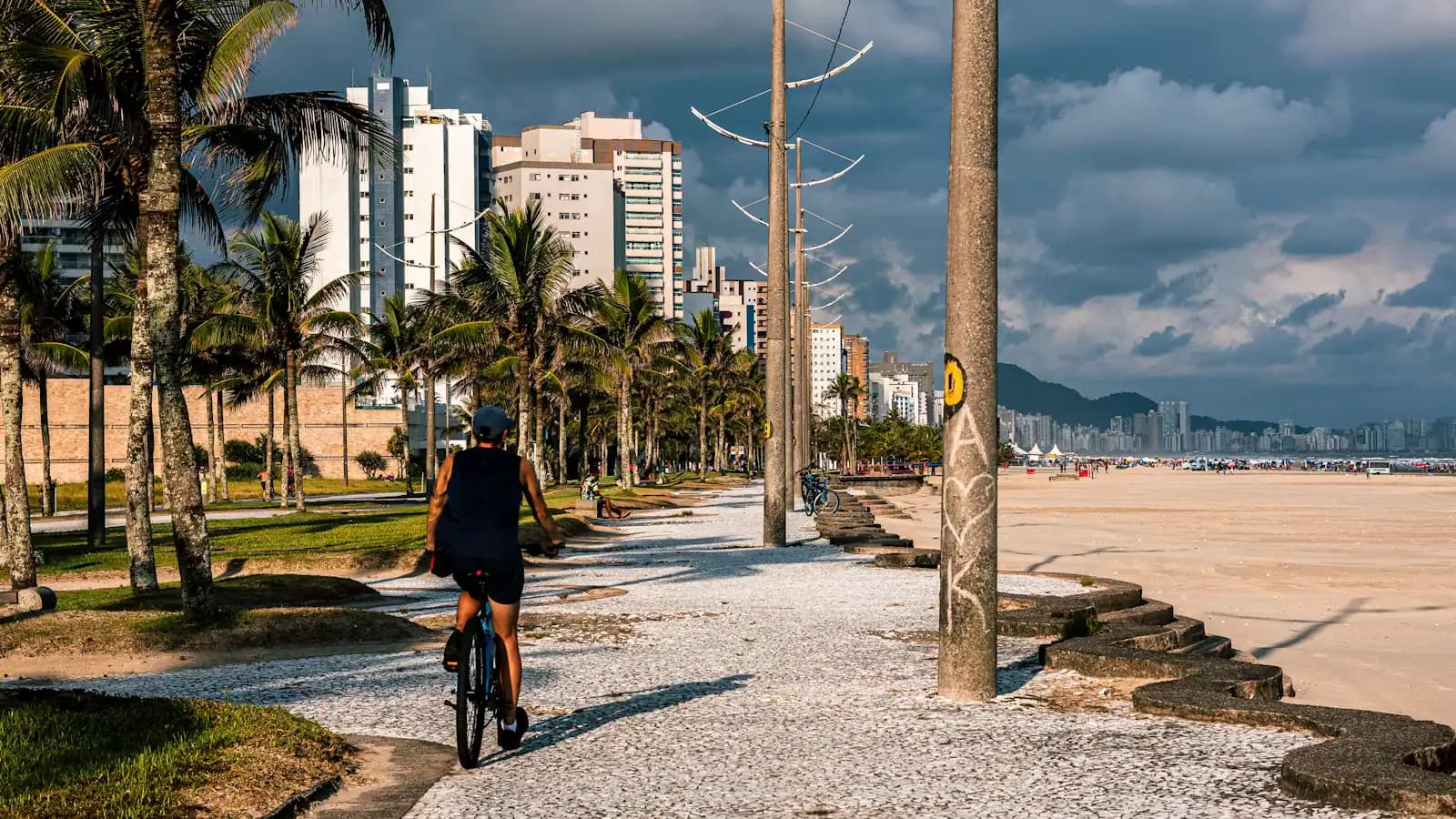
A cyclist riding a paved shoreline path lined with palm trees under heavy cloud
Unsplash

Things to Do

Free Things to Do in Biloxi: A Genuinely Cheap Coast

Last updated

Biloxi costs less than any Gulf coast town its size. Free parking, 26 miles of beach, a bridge path over open water and a memorial worth an hour.

Most coastal towns charge you for the privilege of arriving. A beach parking permit, a per-hour lot, a chair-and-umbrella concession that owns the sand in front of the dune line, five dollars to cross a bridge. Biloxi does almost none of that, and the reason is not civic generosity. It is that eight casino resorts are competing for the same regional visitor and none of them will be the one that charges for the car park.

The consequences run right through a trip. Parking at the casino properties along the beach road is generally free and usually includes valet, whether or not you are staying there, which along a highway with limited kerbside space is a significant thing to be handed. The public beach that runs about twenty-six miles along the Harrison County shore has free roadside parking in marked bays for effectively its whole length, so you drive until you see an empty stretch and stop. There is no entry fee, no permit and no concession that owns the sand.

Then there is the best view on the coast, which is also free. The Biloxi Bay Bridge carries a twelve-foot walking and cycling path on its Gulf side, separated from six lanes of traffic, running roughly a mile and a half between Biloxi and Ocean Springs with open water on both sides. The span opened in November 2007 after the previous bridge was destroyed in 2005, and putting that path on it was one of the better decisions made during the rebuilding.

Add the 1848 lighthouse standing in the median of US 90, the Town Green and the Katrina Memorial downtown, the working harbour at Point Cadet where the shrimp boats tie up, and the whole of Ocean Springs' old downtown across the bay, and you have several days that cost you nothing but fuel.

Two honest limits before the list. First, the beach is free and the water needs checking: the state samples it and posts water-contact advisories after heavy rain. Second, the genuinely unmissable thing in this destination, the ferry out to Ship Island, is the one big ticket, and no amount of resourcefulness gets round it. Budget for that one and take everything else for nothing.

Why this coast costs so little

It is worth understanding the mechanism, because it tells you what else to expect.

Casino competition gives away the parking. Eight resorts inside the city limits are chasing the same drive-in audience from Mississippi, Alabama and Louisiana. Parking is generally free, valet included, at most properties and you do not have to be a guest. Confirm at the property, because a resort can introduce a charge, but the default on this coast is still that you drive up and leave the car.

The beach is a public works project, not a resort amenity. It was recommended by the Corps of Engineers after the 1947 hurricane as a way of protecting the seawall carrying the beach road, built in 1951 and 1952, and promoted at the time as the longest man-made beach in the world. It belongs to the county. That is why there is no gate and no concession with a monopoly on the sand.

Roadside parking runs the length of it. Marked bays along US 90 for effectively the whole twenty-six miles, plus larger lots at the piers and main access points. The popular spots fill on a summer weekend and a quarter of a mile further west is empty.

Rooms collapse in price out of season. Midweek in January or November on this strip is as cheap as an oceanfront room gets in the United States, which is the single biggest saving available and nothing to do with sightseeing.

The flip side, stated once: the things that do cost money here are the ones needing a hull. The island ferry and the fishing charters are the real line items in a Biloxi budget.

The bridge path, walked properly

A long low road bridge crossing a wide expanse of open waterUnsplash
A long low road bridge crossing a wide expanse of open water

Local tips

Treated as a walk rather than a view, here is what you need to know.

  • Distance. Roughly a mile and a half across, so about three miles there and back. Half an hour each way at a walking pace, ten minutes or so on a bike. No gradient to speak of.
  • Where to start. There is parking at both ends. Starting on the Ocean Springs side means you finish at the town rather than at a highway, which suits an evening; starting in Biloxi suits a morning walk you want to be back from.
  • There is no water and no shade. None, for the whole crossing. Carry a bottle. Between June and September do not attempt it in the middle of the day.
  • Fishing is part of what the path is for. Bump-outs along it are used by anglers, and Mississippi requires a saltwater licence for most adults fishing from structures like this. Check the current rule with the state rather than assuming.
  • Wind is the variable. Open water on both sides and nothing to break it. A stiff southerly makes the crossing hard work.
  • Storms. From June through August the afternoon thunderstorms build inland and come back over the coast fast. A mile and a half of exposed concrete with nowhere to shelter is somewhere to leave early.
  • What you will see. Brown pelicans at eye level below the rail, dolphins in the channel more often than not, shrimp boats running into the Back Bay, and the full geography of the peninsula laid out at once.
  • Lighting is patchy after dark. Take a torch if you plan to walk back late.

Downtown: the lighthouse, the Town Green and the memorial

A paved pathway running between green grass under an overcast skyUnsplash
A paved pathway running between green grass under an overcast sky

The one part of the city that works entirely on foot, and it is free.

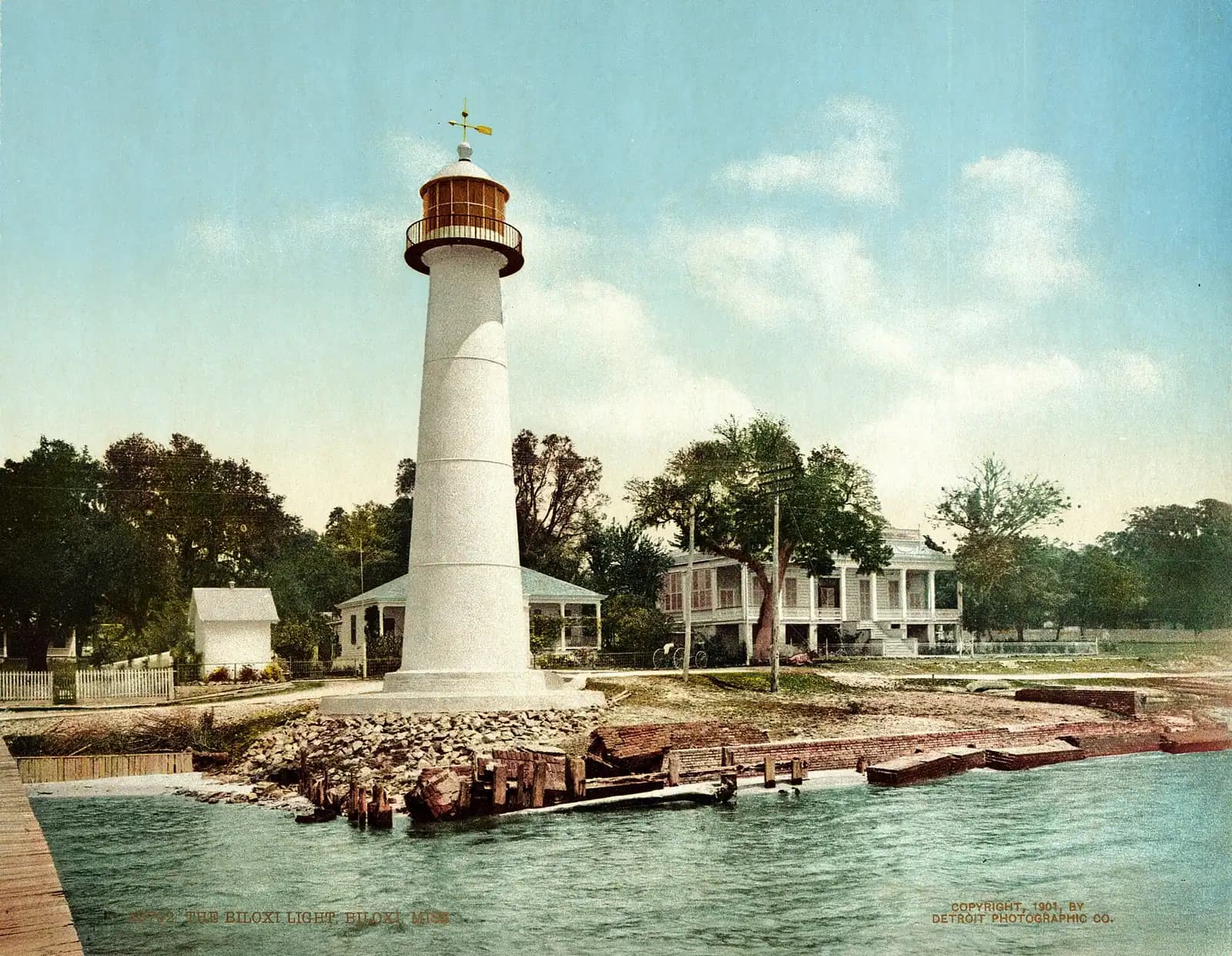
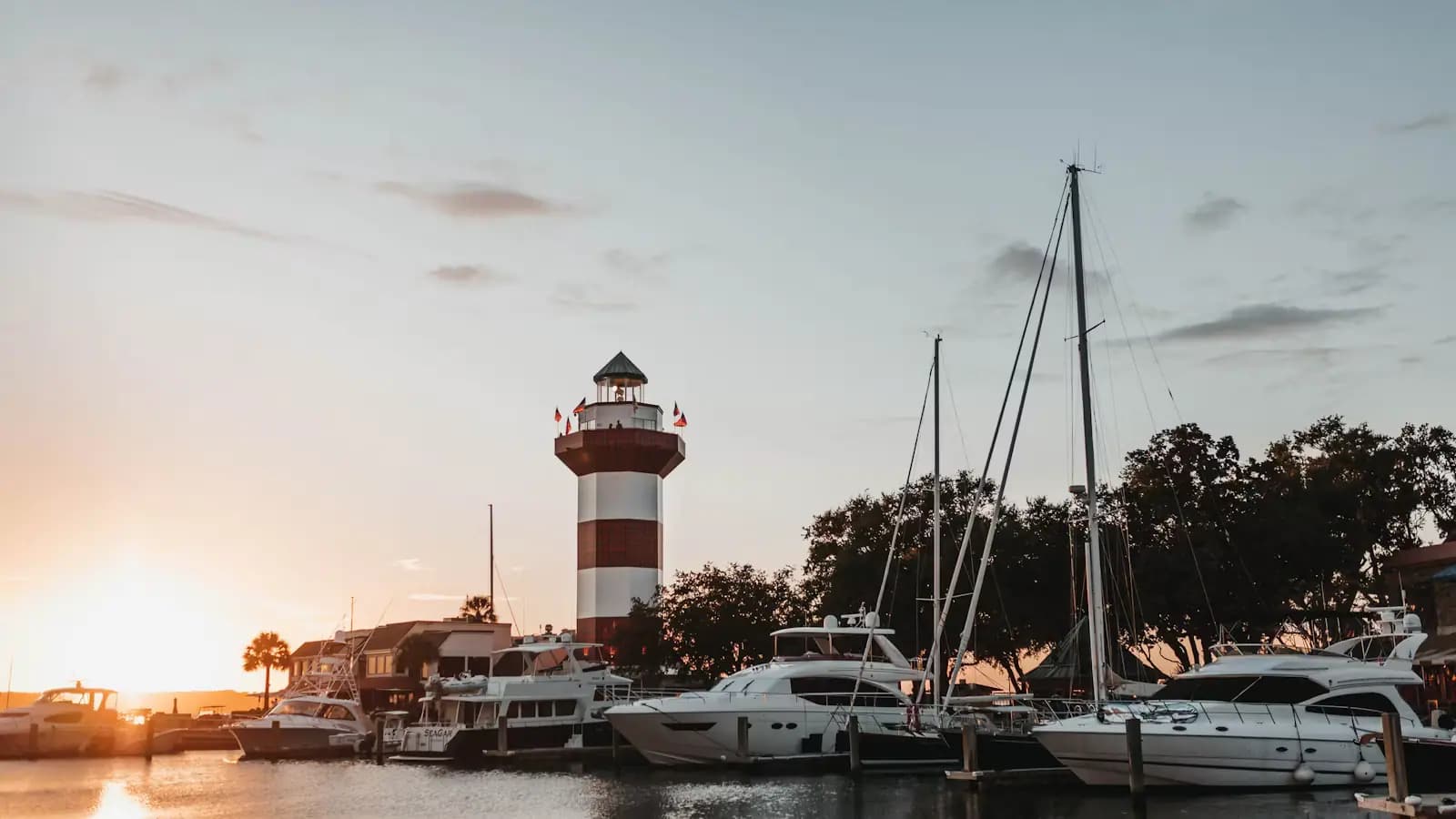
The Biloxi Lighthouse stands in the median of US 90, cast iron, first lit in 1848, a bit over sixty feet tall, with two lanes of traffic passing on each side. It is free to look at, free to photograph and reached by a signalled crossing rather than a stroll, so use the lights. Going up inside is a ticketed tour run through the visitors centre opposite, and the schedule changes, so ask there rather than assume.

The Biloxi Visitors Center on the north side of the highway is free to walk into and is the most reliable place on the coast to find out what is actually open and running this week.

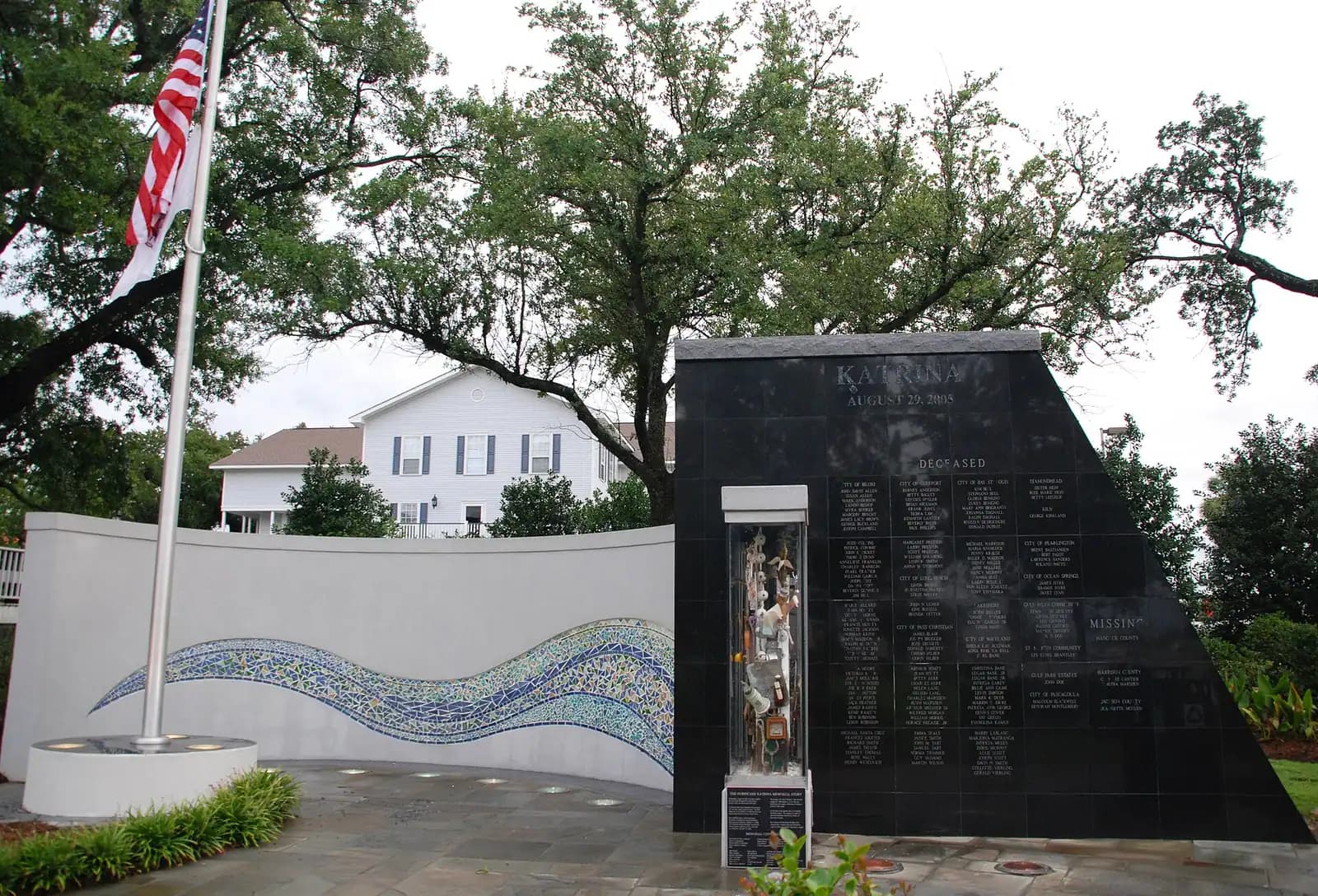
The Katrina Memorial on the Town Green carries a hundred and seventy names. It costs nothing, it takes twenty minutes and it is the single thing most likely to change how the rest of your trip reads. Katrina's surge ran to roughly twenty-two feet here on 29 August 2005 and a 34.1-foot high-water mark was recorded on the Beau Rivage tower, the highest measured in any United States hurricane.

The Town Green itself is open ground with live oaks, used for events through the year, and a good place to sit.

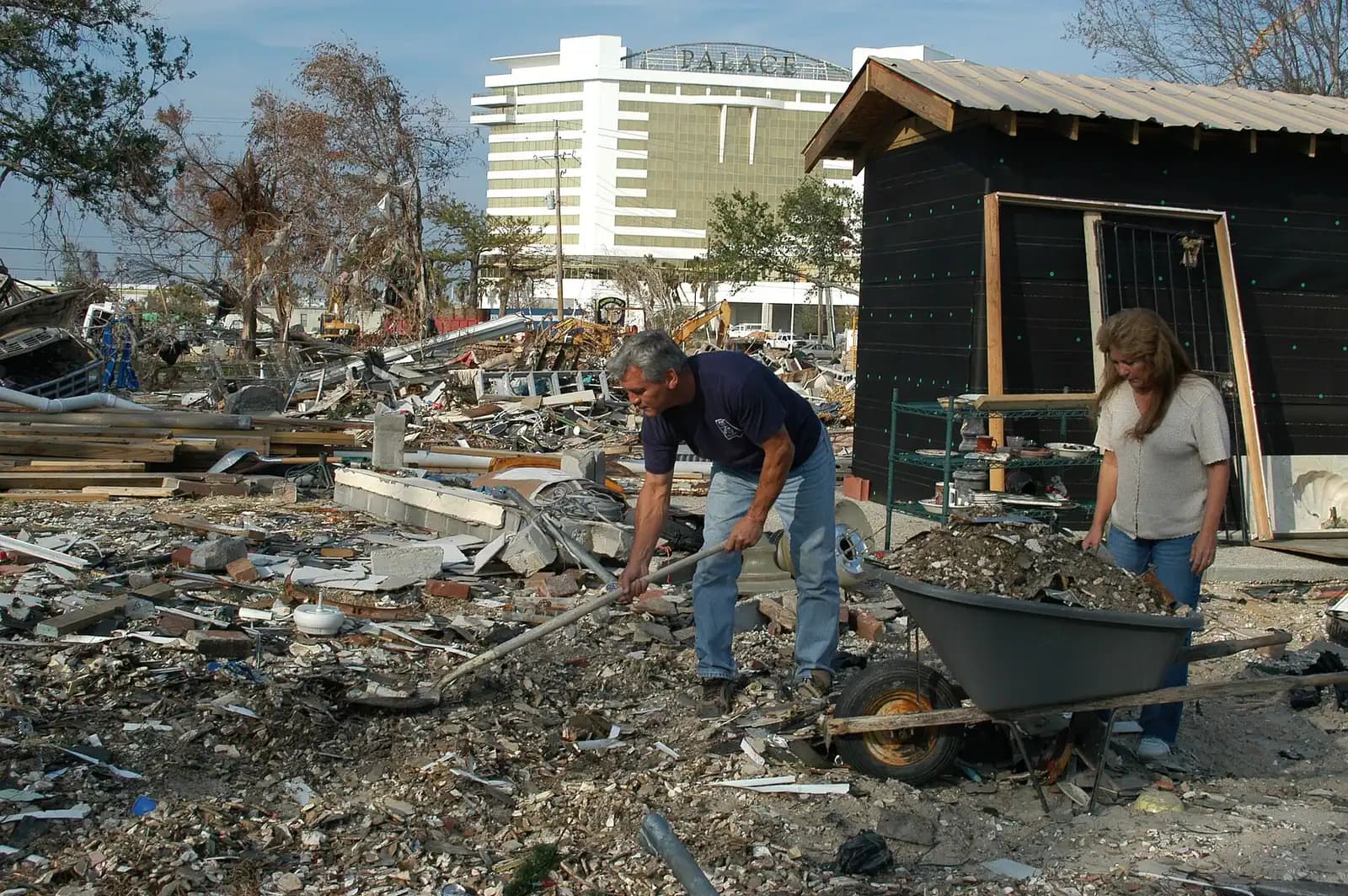
Reading the waterfront is the free activity nobody lists. Walk a mile of Beach Boulevard and look at what is not there: long grassy gaps between buildings, flights of front steps going up to nothing, live oaks killed by salt water and carved into sculptures. That is all one morning in 2005, and once you see the pattern you cannot stop seeing it.

The working harbour, free at the right hour

Rows of boats moored in a marina basin on flat water at first lightUnsplash
Rows of boats moored in a marina basin on flat water at first light

Point Cadet is the eastern tip of the peninsula, five minutes from the casino strip, and it is the part of Biloxi that still does what Biloxi is known for. Almost nobody walks it.

The Small Craft Harbor is a working basin. There is no gate and no ticket. What there is, at the right time of day, is a fleet: shrimp boats coming in and going out, ice going aboard, nets being mended on the dock, gulls and pelicans working the scraps. Early morning and the hour or two before dark are when something is happening; the middle of a hot afternoon is dead.

Beside it stands the schooner pier, where the Maritime and Seafood Industry Museum keeps two replica Biloxi schooners, the Glenn L. Swetman and the Mike Sekul. Sailing on them is ticketed and seasonal. Walking out and looking at them is neither.

This is also the neighbourhood where the Vietnamese-American families who reshaped the fleet from the late 1970s settled, after coming to the coast for cannery work and then buying boats of their own. By the end of the 1980s roughly half of Mississippi's shrimpers were Vietnamese. That history is legible on the docks and in the food nearby, and it costs nothing to notice.

The museum itself has an admission charge and is worth it. But an hour at the harbour with your hands in your pockets is a genuinely good free hour, and it is the closest this coast gets to seeing the industry rather than an exhibit about it.

Free further along the coast

Two drives, both worth the fuel.

East to Ocean Springs. Fifteen minutes over the bridge, or free on foot if you walk the path. The old downtown around Washington Avenue is the most walkable few streets on the Mississippi coast and costs nothing to wander: low buildings under live oaks, galleries, independent shops. The Walter Anderson Museum of Art charges admission. The murals Anderson painted for the Ocean Springs Community Center next door, roughly three thousand square feet of them, are in a working public building, and access depends on what is happening there, so ask rather than assume. The shoreline and the harbour on that side are free and quiet.

West to Gulfport and beyond. Jones Park at the Gulfport harbour is free, has green space and a playground, and is where the Ship Island ferry sails from, which makes it a decent hour if you are killing time before a sailing. Keep going west through Long Beach to Pass Christian and the beach gets steadily emptier, the harbour is a working one, and the oak-lined streets behind the beach road are worth a slow drive.

And the whole length of US 90 itself, which is a scenic drive by default rather than by design: a signalled four-lane road with the Sound on one side the entire way. It is slow, which is the point. Do it once at the end of the day heading west with the light on the water.

One thing to note about all of the above: none of it involves a ticket booth, which after a week on most of the American coast is a novelty in itself.

What people assume is free here and is not

What it costs

Being clear about this saves an argument at a counter.

The ferry to Ship Island is the big one. It is a per-person fare with a reduced child rate, and it is the largest single line in a normal Biloxi day. There is no free alternative, no public boat and no way to walk. It also only sails from the middle of March to the end of October.

Museums charge. The Maritime and Seafood Industry Museum, the Ohr-O'Keefe Museum of Art, the Walter Anderson Museum and Beauvoir all have admission. The coast's museums broadly sit in the ten to fifteen dollar range for an adult, with the Ohr-O'Keefe published at around twelve at the time of writing, and the Mississippi Aquarium in Gulfport is a considerably larger ticket. All of those move; confirm before you go.

Climbing the lighthouse is ticketed, even though looking at it is not.

Sailing the schooners is ticketed, even though the pier is not.

Fishing from a pier or the shore needs a Mississippi saltwater licence for most adults. It is inexpensive and it is not optional.

Parking is free almost everywhere and not quite everywhere. Downtown around the Town Green there are metered and time-limited street bays, and the Gulfport ferry terminal lot at Jones Park is finite and fills before a sailing.

A casino room is cheap, not free, and a resort can add a fee. Read what you are booking.

Twenty-six miles of free beach, and the caveats

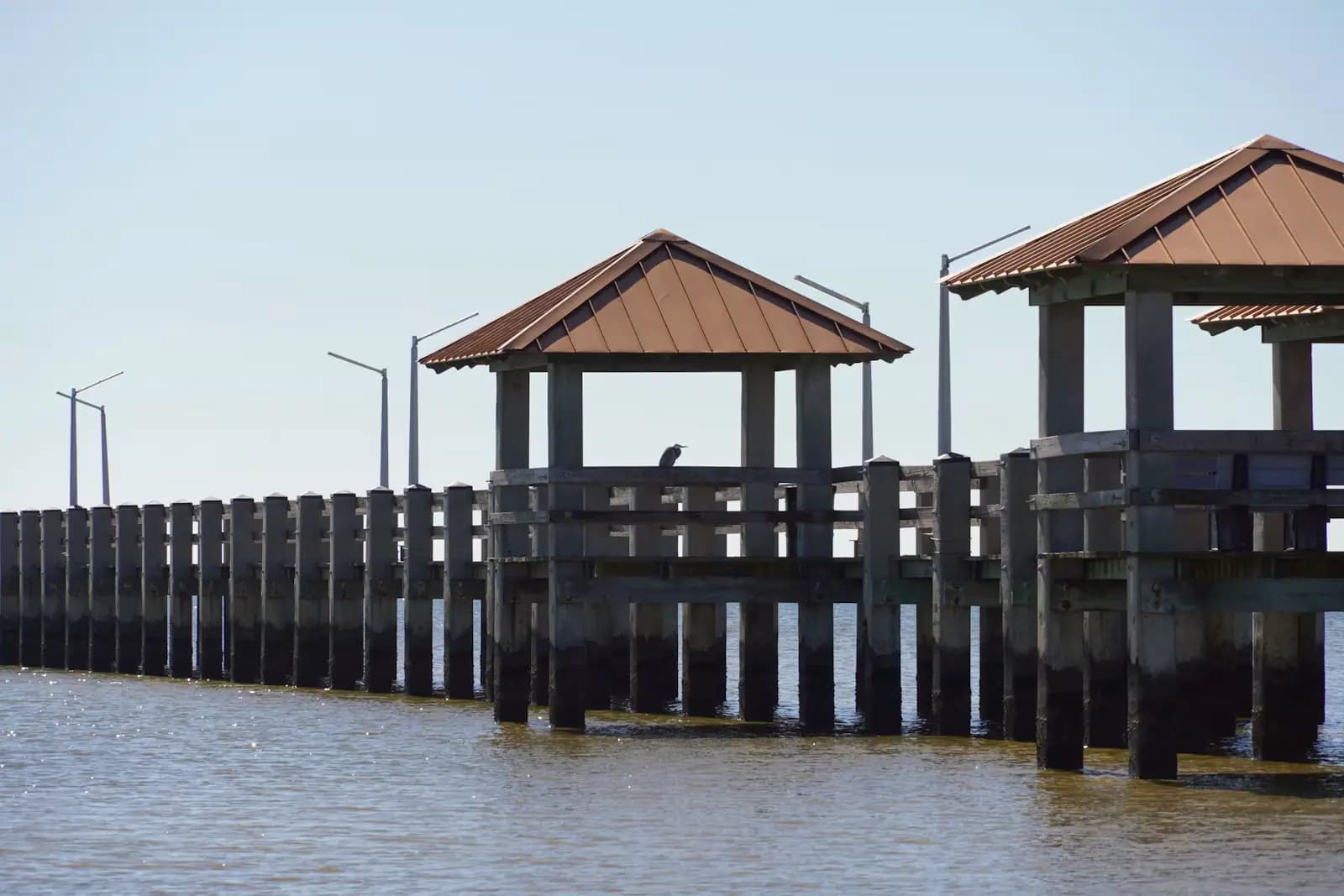
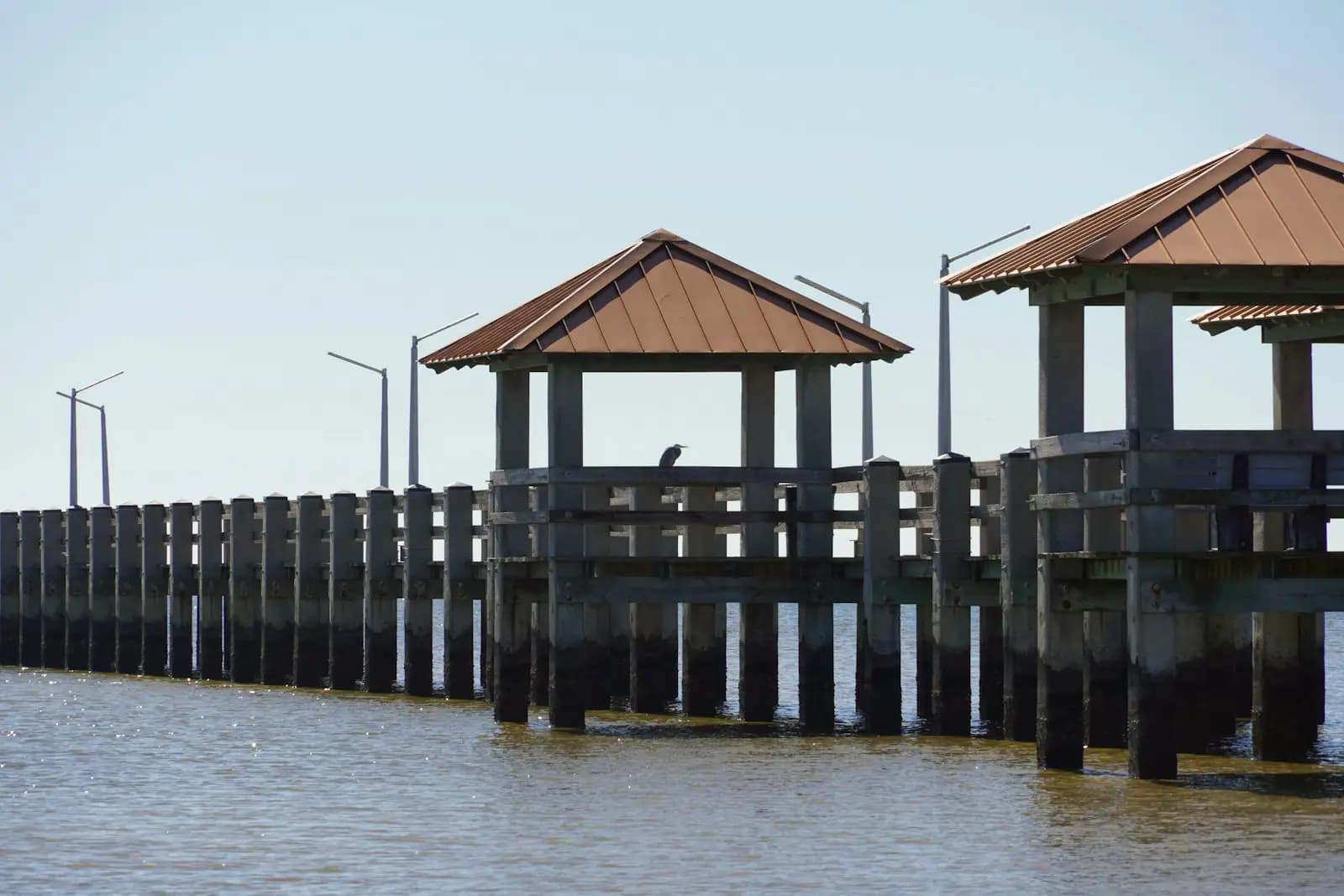
A long low fishing pier with covered shelters standing over flat brown water under a pale skyUnsplash
A long low fishing pier with covered shelters standing over flat brown water under a pale sky

Before you book

The sand along US 90 costs nothing to use and nothing to park beside, and both of those are unusual on the Gulf.

What you are getting: an artificial beach, pumped and graded in 1951 and 1952 to protect the seawall behind it, running about twenty-six miles along the Harrison County shore. It fronts the Mississippi Sound rather than the open Gulf, so the water is shallow a long way out, warm from May into October, usually tea-coloured because five river systems drain into it, and effectively without surf.

That makes it excellent for wading and paddling with small children, pleasant for a long flat walk, good for kite flying in the sea breeze, and unsuitable for anybody who came for waves.

The caveats are genuine.

Check the water-contact advisories. The state environmental agency samples the beaches and posts advisories, and after heavy summer rain they are common rather than exceptional. In 2019 prolonged Bonnet Carre Spillway openings put an estimated ten trillion gallons of river water into the Sound over a record 123 days and closed all twenty-one Mississippi beaches to water contact that June.

There are no lifeguards along most of it.

There is almost no shade. The dunes are low, the road is right behind you, and you should bring your own.

Shuffle your feet in warm months for stingrays, and expect jellyfish in late summer.

Sand is not the whole coast. The piers along US 90 are free to walk out on and give you the water without wading into it.
On the ground

Where to go

Every place below has its own page — hours, parking, what it costs and what to expect when you get there.

  • Landmark

    A lighthouse rising above a low building at the water's edge
    Free

    Biloxi Lighthouse

    An 1848 cast-iron tower marooned in the median of a four-lane highway, kept for sixty-three years by one family of women.

    0.5–1 hoursFree to see and photograph from the street or the beach. Climbing the tower carries a small fee when climbs are running.

  • Historic site

    A low historic brick fortification standing at the edge of calm coastal water
    Free

    Fort Massachusetts

    A brick coastal fort on a barrier island, held during the Civil War by one of the first Black regiments in United States service.

    0.5–1 hoursFree. There is no charge for the fort or for landing on the island — the cost of the visit is the ferry ticket or the charter.

  • Historic site

    Spanish moss hanging in curtains from the spreading limbs of a live oak
    Free

    Katrina Memorial

    A monument on the Town Green carrying the names of people who died in this city on 29 August 2005.

    15–30 minutesFree. There is no ticket and no attendant.

  • Neighbourhood

    A palm-lined pedestrian street with low shopfronts and cafe tables set out along it
    Free

    Ocean Springs

    Two miles east across Biloxi Bay: galleries, live oaks, a walkable main street and the site of the first French settlement on this coast.

    2–6 hoursFree to visit. Galleries are free to browse; the museum and Shearwater are separate.

  • Beach

    Low evening sun over a wide empty beach with wet sand reflecting the sky
    Free

    Biloxi Beach

    Miles of public sand along the beach highway, free to use, shallow a long way out, and with no shade anywhere on it.

    1–4 hoursFree. The sand is public along its whole length and parking along the frontage is free in most places.

  • Marina

    Rows of boats moored in a marina basin on flat water at first light
    Free

    Biloxi Small Craft Harbor

    A working harbour of trawlers and charter boats on the Sound side, best at dawn when they leave and at four when they come back.

    0.5–1.5 hoursFree to walk and watch. Boat trips, charters, fuel, ice and ramp use are charged by the operators.

  • Entertainment

    An evening crowd gathered under strings of festival lights
    Free

    Hard Rock Hotel & Casino Biloxi

    Eight days from its opening night when Katrina destroyed it, and now home to the only free museum-grade collection in Biloxi.

    1–3 hoursFree to walk in and see the memorabilia collection. Rooms, dining and concert tickets are priced separately.

  • Nature preserve

    A timber boardwalk curving through dense swamp woodland above still dark water
    Free

    Gulf Islands National Seashore — Davis Bayou

    The only piece of the national seashore in Mississippi with a road to it: oaks, boardwalks, a bayou and a staffed visitor centre.

    1–3 hoursFree to enter and to walk. Camping is charged.

  • Neighbourhood

    A harbour basin filled with moored small boats seen from above
    Free

    Point Cadet

    The headland where the canneries stood for a century and where Mississippi's coastal casino era began in 1992.

    1–3 hoursFree to walk. The museum and the schooner sailings are ticketed separately.

  • Nature preserve

    Aerial view of a narrow strip of undeveloped pale sand between green water and dense pine forest
    Free

    Deer Island

    Four hundred acres of state-owned pine and marsh a short paddle off the beach road, with no ferry, no dock and nothing built on it.

    2–5 hoursFree. The cost is the boat.

  • Water feature

    A floating dock on a sheltered bayou with flat water stretching to a low far shore
    Free

    Back Bay of Biloxi

    The sheltered estuary behind the peninsula, where the shrimp grow up and the fleet goes to hide from hurricanes.

    0.5–4 hoursFree. Public ramps, bridges and shoreline access cost nothing, though some ramps may charge for launching.

  • Landmark

    A lighthouse rising above a low building at the water's edge
    Free

    Biloxi Visitors Center

    Free parking, restrooms and a staffed desk opposite the lighthouse, in a city where half of what you want to do is seasonal.

    15–45 minutesFree, including parking. Lighthouse climbs are ticketed separately when they run.

  • Historic site

    A wooden house with wide verandahs shaded by mature trees

    Magnolia Hotel

    An 1847 hotel, the oldest left on this coast, which survives because the city picked it up in 1972 and moved it back from the water.

    15–45 minutesAny interior admission has been modest, and the exterior and site cost nothing.

Straight answers

Questions people actually ask

Is Biloxi Beach free?

Yes, and so is the parking. The sand runs about twenty-six miles along the Harrison County shore with free roadside bays in marked spaces for effectively its whole length, plus larger lots at the piers. There is no gate, no permit and no concession owning the sand, because the beach was built as a public works project in 1951 and 1952 to protect the seawall rather than as a resort amenity. Check the state's water-contact advisories before swimming.

Do you have to pay to park at Biloxi casinos?

Generally not, and that usually includes valet, whether or not you are a hotel guest. Eight resorts competing for the same regional audience keeps it that way. Confirm at the property, because a resort can introduce a charge and policies do change. The exceptions on this coast are the metered street bays downtown around the Town Green and the finite ferry terminal lot at Jones Park in Gulfport, which fills before a sailing.

Can you walk across the Biloxi Bay Bridge for free?

Yes. The span carries a twelve-foot shared walking and cycling path on its Gulf side, fenced off from the traffic, running roughly a mile and a half between Biloxi and Ocean Springs, and there is parking at both ends. It takes about half an hour on foot each way. There is no shade, no water and nowhere to shelter for the whole crossing, so avoid summer afternoons and leave early if storms are building to the north.

Is the Biloxi Lighthouse free to visit?

Free to see and photograph, ticketed to climb. It stands in the median of US 90, cast iron and first lit in 1848, reached by a signalled crossing rather than a casual dash across four lanes. Climbing tours are run through the Biloxi Visitors Center on the north side of the road opposite, and the schedule changes with the season and with staffing, so ask there rather than turning up expecting a fixed time.

What can you do in Biloxi with no money?

A full day without spending anything: walk the bridge path at sunset, spend an hour at the Small Craft Harbor at Point Cadet while the boats are working, read the Katrina Memorial on the Town Green, look at the 1848 lighthouse from the pavement, walk out on one of the US 90 piers, and drive west along the beach road at the end of the day. Park free at a casino garage and the fuel is your only cost.

Is there a free way to get to Ship Island?

No. The only scheduled public access is the ferry from Jones Park in Gulfport, run by an authorised National Park Service concessionaire, and it charges a per-person fare with a reduced child rate. It is the largest single expense of a normal day in this destination. The island is twelve miles offshore, the crossing takes about an hour each way, and sailings run only from the middle of March to the end of October.

Are there free museums in Biloxi?

Not as a rule. The Maritime and Seafood Industry Museum, the Ohr-O'Keefe Museum of Art, Beauvoir and the Walter Anderson Museum across the bay all charge admission, broadly in the ten to fifteen dollar range for an adult with the Ohr-O'Keefe published at around twelve at the time of writing. The free history on this coast is outdoors: the memorial, the lighthouse, the harbour, and the gaps along Beach Boulevard where buildings stood before 2005.

Is Biloxi cheaper than other Gulf Coast destinations?

Materially, yes, and for structural reasons rather than seasonal ones. Casino competition keeps parking free, the county beach has no entry fee or permit, and midweek winter room rates on this strip are about as low as oceanfront accommodation gets in the United States. What costs money here is anything needing a boat: the island ferry and the fishing charters are the real expenses of a Biloxi trip.