Neighbourhood
Free
Point Cadet
The headland where the canneries stood for a century and where Mississippi's coastal casino era began in 1992.
1–3 hoursFree to walk. The museum and the schooner sailings are ticketed separately.0.2 mi away
Entertainment
Last updated
Mississippi's coastal casino era began on this patch of Point Cadet in 1992, at the quiet end of the strip beside the bay bridge.
Mississippi legalised dockside gaming in 1990, and the first casino in Biloxi opened on this site in 1992 under the name Isle of Capri. Everything else along this beach followed from that: the towers, the twenty thousand jobs, the reshaping of a city that had been living on shrimp, air force training and a fading tourist trade. The building has changed name and owner several times since and is now a Golden Nugget, part of Tilman Fertitta's Landry's group, which bought and reflagged it in the 2010s.
Its position is the reason to care. This is Point Cadet, the eastern tip of the Biloxi peninsula, where the land runs out at the Biloxi Bay bridge across to Ocean Springs. That puts it a mile and a half from the main run of casino towers and, far more usefully, within a short walk of the Maritime and Seafood Industry Museum and the schooner pier. Almost nothing else on this coast lets you stay in a casino hotel and walk to a working piece of maritime heritage before breakfast.
The east end also changes the view. Rooms on the correct side look out over Biloxi Bay, the bridge and the small-boat traffic rather than over four lanes of US 90, and the water on that side is the estuary rather than the open Sound.
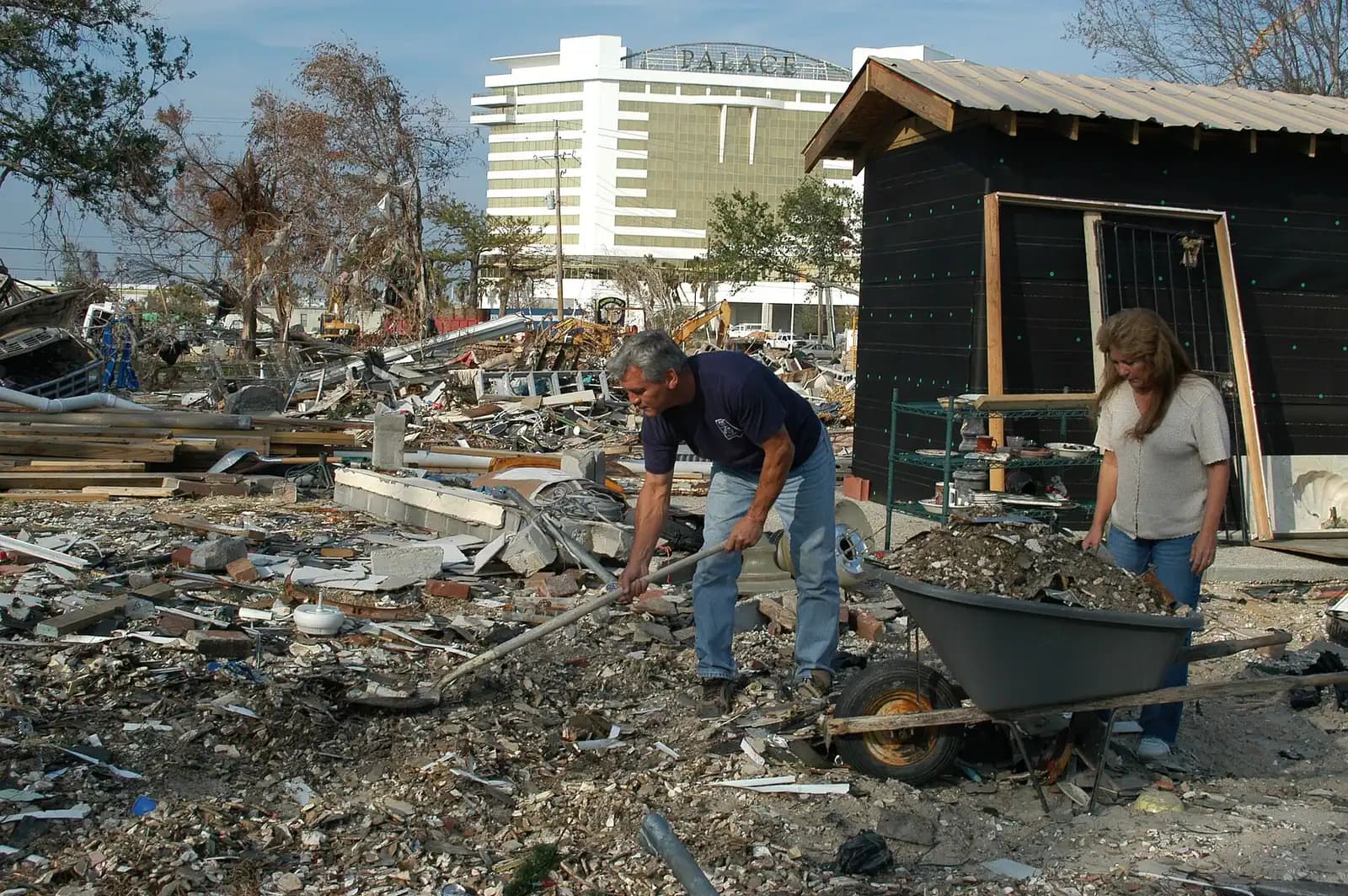
What happened here in 2005 is worth knowing because it explains the whole architecture of Mississippi gaming. The casino was destroyed; the hotel was not. Before Katrina the law required coastal gaming floors to float, so the tables and machines sat on a barge alongside a perfectly solid hotel — and the surge took the barge apart while the concrete stayed up. The law changed months later.
For a non-gambler: a large pool, bay views, and a dining line-up that is worth understanding before you book, because every name on it belongs to the same company that owns the building.
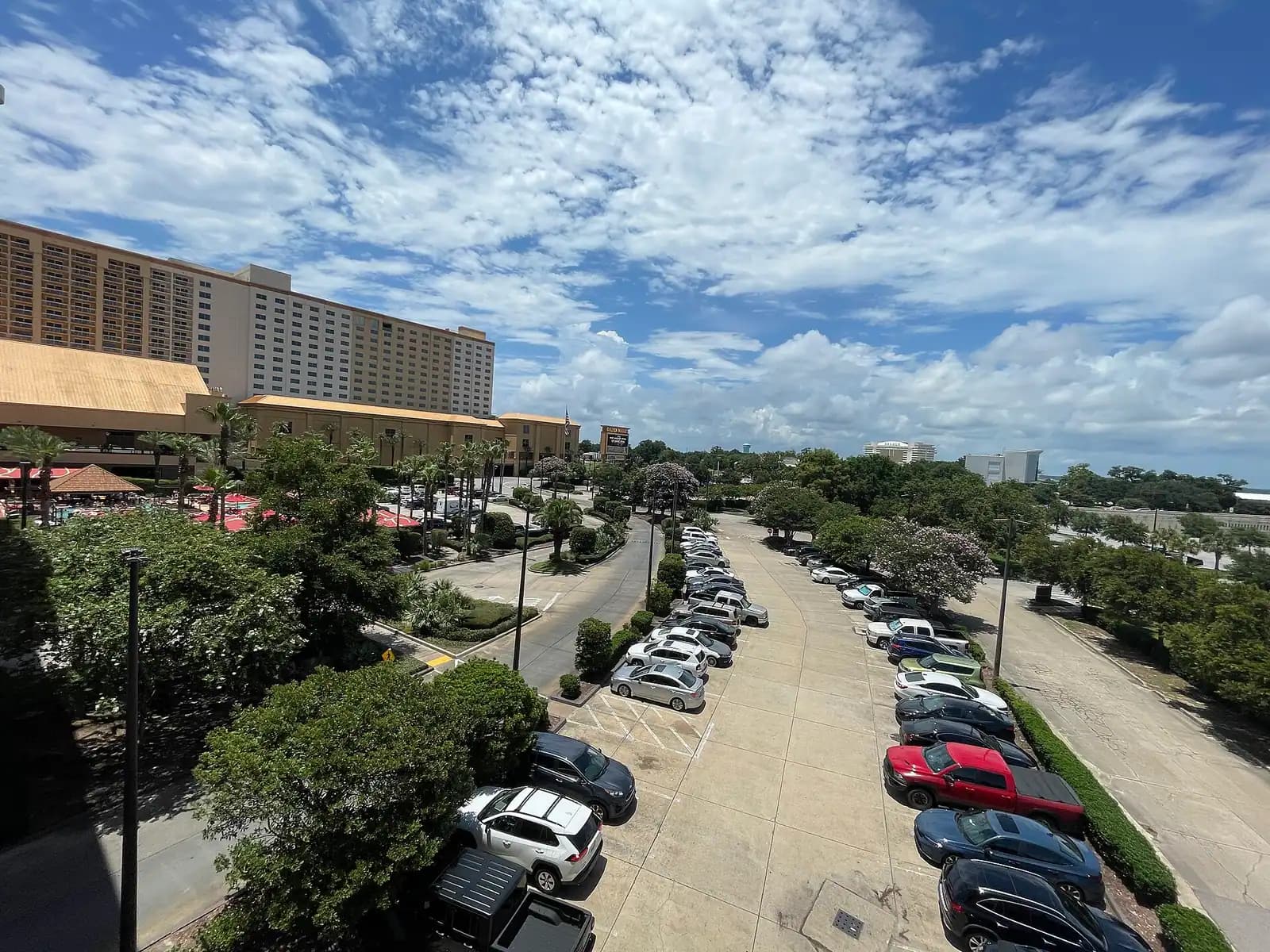
The resort sits at the eastern end of the Biloxi peninsula on Point Cadet, immediately west of the US 90 bridge over Biloxi Bay. Coming from Ocean Springs you cross the bridge and it is the first thing on your left; coming from the main casino strip, drive east along the beach road until the land runs out.
Self-parking has generally been free at the coast casinos, with a garage on site and valet at the entrance.
This is the one Biloxi resort where walking genuinely works. The Maritime and Seafood Industry Museum and the schooner pier are a few minutes away on foot, and Point Cadet's marina and waterfront are closer still. The main strip, the lighthouse and the Katrina Memorial are not walkable from here in summer heat — plan on driving those.
From Gulfport-Biloxi International Airport allow around twenty-five minutes. Amtrak's Gulf Coast service stops in Biloxi, and the station is a short drive west.
The Mississippi Gaming Control Act passed in 1990 and permitted gaming vessels on the Mississippi River and on the waters of the Gulf Coast counties. Nobody involved expected what followed. Within a decade the coast had a casino industry employing a significant share of Harrison County, and the state had a tax base that changed what its coastal cities could afford.
Biloxi's first opened on this site in 1992 as the Isle of Capri, and the format tells you everything about the law that created it. The hotel, the restaurants and the parking were on land. The gaming floor was on a barge in the water, moored alongside, connected by a walkway, so that in the letter of the statute the gambling was happening on a vessel. Every coastal casino in Mississippi was built to that shape.
That is why the buildings sit hard against the water on the wrong side of a highway, and why the ground floors of the older ones feel like they were designed around a connection that no longer exists. It is also why the storm destroyed so much of the industry in a morning.
Standing at Point Cadet today you are looking at the start of that and at the end of something else. This was the cannery district: the seafood industry's centre of gravity for a century before the casinos arrived. Two industries, one headland, and almost nothing left standing from the first.
The choice between staying at Point Cadet and staying in the middle of the strip is not about the casino floor, which is much the same everywhere. It is about what you can reach on foot.
| Point Cadet (east end) | Mid-strip (Beach Boulevard) | |
|---|---|---|
| Walk to a museum | Maritime and Seafood Industry Museum, a few minutes | Ohr-O'Keefe is a walk or a short drive |
| Walk to a boat | Schooner pier and Point Cadet marina | Small Craft Harbor, further |
| Outlook | Biloxi Bay, the bridge, small-boat traffic | US 90 and the Sound |
| Other casinos on foot | Effectively none | Several, along the beach road |
| Ocean Springs | Over the bridge in minutes | Add fifteen minutes |
| Lighthouse and Katrina Memorial | A drive | Walkable |
The honest summary: if your trip is built around the casinos, stay mid-strip and walk between them. If it is built around the water, the seafood story and a day trip to Ocean Springs — which is the better Biloxi trip for most people — the east end puts you next to all three.
The bay bridge is the other advantage. Ocean Springs, with its arts district and the Walter Anderson Museum, is minutes away from here rather than a project, and that is the single best half-day on this coast that does not involve a ferry.
This is not a criticism, but it is a thing to know. Landry's, which owns the resort, also owns a large portfolio of American restaurant brands, and the dining at a Landry's casino is drawn from that portfolio. At various points the line-up here has included Bubba Gump Shrimp Co., Saltgrass Steak House and Morton's — all of them Landry's brands.
The consequence for a visitor is predictability in both directions. You know exactly what you are getting, the service standards are chain standards, and nothing will be a disaster. You also will not eat anything in this building that you could not eat in Houston or Orlando, which on a coast whose entire culinary identity is local shrimp, oysters and Vietnamese-Cajun cooking is a genuine loss.
The practical advice is simple. Eat breakfast and a late-night meal in the resort because it is convenient, and eat at least one proper seafood meal outside it. Point Cadet and the Back Bay have working seafood places that have been feeding boat crews for longer than the casinos have existed, and the whole point of coming to a city that called itself the Seafood Capital of the World is to eat what came off the boats.
The seafood and dining page covers where to go and what is in season.
Advertised room rates on this coast are frequently low — genuinely low compared with anywhere in Florida — and they are low for a reason. The business model assumes a proportion of guests will spend money on the gaming floor, and rooms are priced to fill the building rather than to cover themselves.
Two things move the real number. The first is the resort fee, a per-night charge added at checkout that covers internet, pool access and whatever else a given property has bundled into it. Whether one applies, and how much, varies by property and by season, and it is disclosed at booking rather than in the headline rate. Read the total, not the nightly figure.
The second is the day of the week. Midweek rates here can be a third of a Saturday, because the coast fills from Jackson, Mobile, New Orleans and Hattiesburg at weekends and empties on Monday. If your dates are flexible, moving a trip from Friday-Saturday to Tuesday-Wednesday is the single biggest saving available in Biloxi.
Self-parking at coast casinos has generally been free, which is not the case in Las Vegas and is worth a line in your budget comparison. None of these figures are published here because operators change them without notice — check the total at the point of booking.
Straight-line distances, so allow more on the road — the island is long and has one main parkway.
Neighbourhood
The headland where the canneries stood for a century and where Mississippi's coastal casino era began in 1992.
1–3 hoursFree to walk. The museum and the schooner sailings are ticketed separately.0.2 mi away
Museum
Canneries, schooners, net-making and the Vietnamese shrimp fleet: the museum that explains why Biloxi is here at all.
1.5–2.5 hoursA modest admission charge for adults, with lower rates for children, students and seniors. Schooner sailings are priced separately.0.2 mi away
Marina

Two sixty-five-foot replicas of the oyster schooners that worked this coast under sail, and you get to help haul the halyards.
2–3 hoursPublic sailings are ticketed at a modest per-person rate, with reduced rates for children. Private charters are priced separately.0.3 mi away
Entertainment

Eight days from its opening night when Katrina destroyed it, and now home to the only free museum-grade collection in Biloxi.
1–3 hoursFree to walk in and see the memorabilia collection. Rooms, dining and concert tickets are priced separately.1.9 mi away
Where this place fits into a day, and the pages that plan one.
Guide hub
Almost everything on this list is on one road or reached from it. US 90 runs the length of the Biloxi peninsula with the Mississippi Sound on the…
Things to do
The law came first, and the architecture is downstream of it. Mississippi legalised dockside gaming in 1990, and the statute carried one condition…
Things to do
The casinos are what people search for and the seafood is what actually made this city. In 1881 the first cannery opened on the water here, and…
Plan your trip
The mistake people make here is not choosing the wrong way to travel. It is assuming that because everything sits on one road, everything is close…
Who it suits
Eight casino resorts operate inside the Biloxi city limits, which for a city of fewer than fifty thousand people is an extraordinary concentration…
Things to do

Set your expectations by the map rather than by the word "strip". Biloxi's resorts are strung along several miles of US 90, a signalled four-lane…
Guide
Eight casino resorts sit inside the city limits because of two changes in Mississippi law, thirty-five years apart. What that means for a visitor who may not gamble at all.
8 min readAdeline Boudreaux
The site was. Mississippi legalised dockside gaming in 1990 and the first casino in Biloxi opened on this patch of Point Cadet in 1992, under the name Isle of Capri. The property has changed hands and names since, and Tilman Fertitta's Landry's group bought and reflagged it as a Golden Nugget in the 2010s. What stands today is not the 1992 building, but the ground under it is where the coast's casino era started.
At Point Cadet, the eastern tip of the Biloxi peninsula, immediately beside the US 90 bridge over Biloxi Bay to Ocean Springs. That is about a mile and a half east of the main run of casino towers. The practical consequence is that you can walk to the Maritime and Seafood Industry Museum and the schooner pier from here, but not to the lighthouse or the Katrina Memorial.
The casino was destroyed and the hotel was not, which sounds odd until you know the law. Before 2005 Mississippi required coastal gaming floors to float, so the tables and machines sat on a barge moored alongside a solid land-built hotel. The surge on 29 August 2005 took the barge apart and left the concrete standing. The legislature changed the rule within months, allowing gaming floors to be rebuilt on land.
It is the best-placed of the Biloxi resorts for a non-gambler, mainly because of where it is rather than what is inside it. Point Cadet puts the seafood museum, the schooner pier and the marina within a short walk, and Ocean Springs is minutes over the bridge. There is a large pool and bay views from the right rooms. The dining is all chain brands owned by the same company that owns the resort.
Some do, and the amount varies by property and season. Headline room rates on this coast are often strikingly low because the business model assumes gaming spend, so the number to compare is the total at checkout rather than the nightly figure. Self-parking has generally been free here, unlike Las Vegas. Midweek rates can be a fraction of Saturday rates, which is the biggest saving available in Biloxi.